
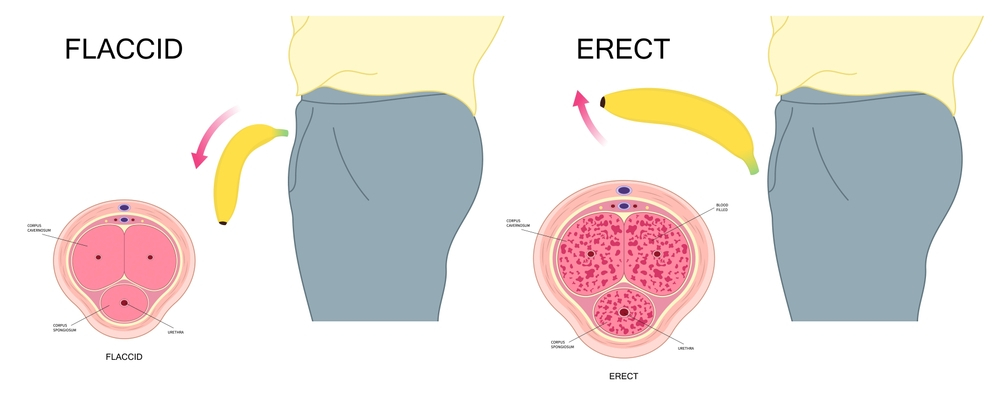
Peyronie’s disease is characterized by the formation of non-cancerous scar tissue (plaques) on the penis (male reproductive organ), resulting in the bending of the penis and making an erection difficult. The condition is also known as “Penile Curvature,” resulting in painful and curved erections.
Peyronie’s disease is a connective tissue disorder affecting 1-23% of men worldwide.
Location of Scar tissue or Plaque
- The scar tissue commonly builds up in the thick elastic membrane inside the penis, known as “Tunica Albuginea.”
Tunica Albuginea is responsible for keeping the penis stiff during erection. However, any abnormal growth can disturb the normal functioning of the penis.
- Approximately 70% of the plaques occur on the top of the penis. This results in the upward and forward bending of the penis during erection.
- The formation of the plaque on the bottom or side of the penis results in the downward and sideways bending of the penis during erection.
Top 4 Facts about Peyronie’s Disease
- The formation of scar tissue (plaque) can occur anywhere in the penis.
- The plaque causes a significant curve in the penis which causes a painful erection and makes sex life difficult for most suffering males.
- This disease causes stress in males.
- The scar tissue or plaque can often be felt through the skin.
It is estimated that up to 10% of men over the age of 40 are affected by Peyronie’s disease.
Physiology of the Penis
Physiology of the Penis
The primary function of the penis is to carry urine and sperm outside the body. Penis consists of three cylindrical chambers or tubes. These tubes are as follows:
- One chamber is known as Urethra, which carries urine from the bladder.
- The second chamber consists of two tubes known as “Corpora Cavernosa.” These are responsible for filling the penis with blood to make it stiff during erection.
- The third chamber is covered with a tough fibrous sheath called “Tunica Albuginea.” It maintains the stiffness of the penis during sexual activity.
Any abnormal mass growth and changes in tissue result in Peyronie’s disease.
Stages of Peyronie’s Disease
Peyronie’s disease has two stages. These are as follows:
- Acute Phase
- Chronic Phase
Acute Phase
During this phase, the plaque lasts about 5 to 7 months; however, in some cases, it lasts up to 18 months after its formation. The following changes occur during the acute phase:
- The formation of scar tissue (plaque) and inflammation of the penis occurs.
- The bending (curve) of the penis occurs.
- Painful penis even in the absence of erection.
- With the development of scars, the erection becomes painful.
Chronic Phase
The chronic phase occurs after the acute stage of the disease. It means the chronic phase starts 12 to 18 months after plaque formation. The following changes occur during this phase:
- Plaque formation and the penile curvature stop and stabilize in their form without causing any further damage.
- Less painful penis.
- The development of erectile dysfunction occurs, and it worsens over time.
Approximately 20-40% of men with Peyronie’s disease experience pain during erections.
What are the causes of Peyronie’s Disease?
The etiology of the disease is not entirely understood. However, some factors can be the cause of the disease. These are as follows:
- The condition can occur as a consequence of injury to the penis.
- Autoimmune disease can be the cause of Peyronie’s disease.
- Bending and pressure on the penis during sex can also result in penile curvature associated with Peyronie’s disease.
- Trauma to the penis during sports activity can also result in the condition.
Researchers are working on the etiology to determine if inheritance or specific conditions can cause Peyronie’s disease.
What are the symptoms of Peyronie’s disease?

Symptoms of Peyronie’s disease
The signs and symptoms of the disease occur suddenly or sometimes appear gradually. Not all plaques result in the bending or curving of the penis. The most common signs and symptoms of Peyronie’s disease are as follows:
- Scar formation
- Pain or inflammation
- Bottle Necking or Waisting – Most plaques narrow the shaft of the penis that, eventually, looks like a bottleneck.
- A significant bend/ curve to the penis
- Lumps in the penis
- Painful erections
- Shortening of the penis
- Soft erections (absence of stiffness of penis during sexual intercourse)
- Difficulty in sexual intercourse due to curve and bending of the penis
Risk factors
Injury to the penis can cause Peyronie’s disease; however, this is not the only cause that can cause this condition. Various other factors contribute to the development of this disease. These are as follows:
- Age – The prevalence of this disease increases with age, especially men over 40 are more likely to suffer.
- Hereditary – If a person has a family history of the disease, it would increase his chances of getting the condition.
- Connective tissue disorders – such as Dupuytren’s contracture, increase your risk of getting the disease.
- Prostate surgery – In rare cases, it also affects the penis.
- Smoking – It results in various changes in the body’s normal functioning.
Complications
Complications are the long-term effects of Pyronie’s disease. The condition is associated with various complications. Some of them are as follows:
- Erectile dysfunction
- Inability to have sexual intercourse
- Reduction in penis length
- Changes in the shape of a penis
- Stress and depression
- Pain in penis
- Greater chances of infertility
Can Peyronie’s disease cause infertility in males?
The acute stage of Peyronie’s disease doesn’t affect male infertility because the disease affects the shape of the penis. However, the function of the penis remains intact such as urination and ejaculation. On the contrary, in severe cases of Peyronie’s disease, sexual activity, such as sexual intercourse, is affected due to the deformed shape of a penis and soft ejaculations. This results in male infertility.
Can Peyronie’s disease cause UTIs?
The disease is characterized by the formation of scar tissue that affects the shape and size of the penis. Therefore, the function of the penis remains intact, and the urination continues, thus preventing the penis from causing any Urinary Tract Infections.
Is Peyronie’s disease contagious?
No, Peyronie’s disease is not contagious, and transmissible diseases can’t cause it.
Does Peyronie’s disease go away on its own?
It is a rare chance that the condition will go away independently. However, the condition remains the same in most cases and worsens over time. Therefore, early diagnosis and treatment can be beneficial in treating and improving the symptoms.