

Lumbar spinal stenosis (stenosis- a Greek word that means narrowing) is a degenerative condition in which the narrowing of the spinal canal occurs at the spinal cord’s lumbar level. The spinal cord is a bundle of nerve fibers that runs through the hollow space formed by the spine’s vertebrae. This hollow space is known as the “Spinal Canal.” Stenosis causes nerve compression and impingement, further affecting the muscles.
Lumbar spinal stenosis affects approximately 200,000 people in the United States each year.
Anatomy of the spine
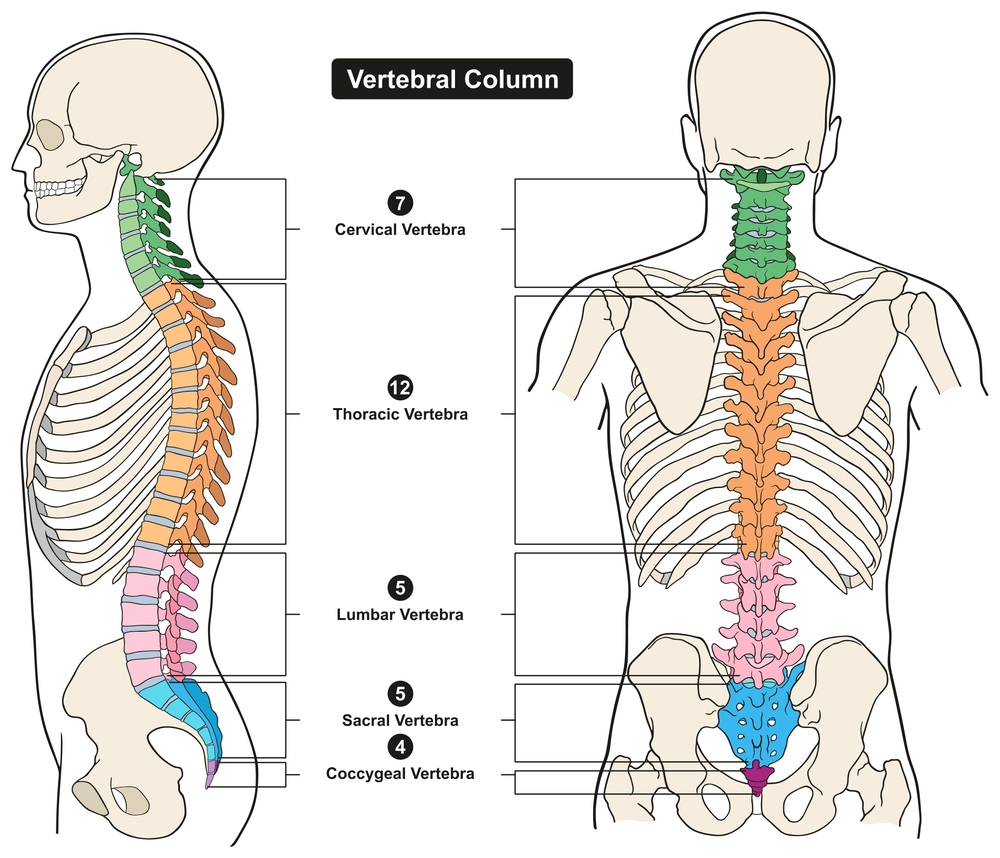
Anatomy of the spine
The human spine comprises 33 small bones known as “vertebrae.” These vertebrae interlock with each other to form a spinal column. Out of 33 vertebrae, five lumbar segments make five pairs of lumbar nerves. Along with vertebrae, intervertebral disks, muscles, ligaments, and nerves are part of the spine. Stenosis in the lumbar region is known as “Lumbar Spinal Stenosis (LSS).” Spinal stenosis can occur at any level of the spine. However, it is common in the lumbar region due to its biomechanics.
Lumbar spinal stenosis increases with age, with an estimated prevalence of 2.4% in those aged 60-69 and up to 8.4% in those aged 80-89. (Source: Spine-health)
What causes lumbar spinal stenosis (LSS)?
The most common cause of lumbar stenosis is the natural aging process, which can lead to the degeneration of the spine and the formation of bone spurs. Another prevalent cause is “Osteoarthritis.” It causes gradual wear and tear of joints resulting in deterioration of the spine in people of age 50 or older. In addition, due to degenerative changes, the disks become less spongy with aging, resulting in loss of disk height, bulging of the hardened disk, and formation of bone spurs occurs as a result.
Other causes
Other conditions and circumstances that can result in LSS are as follows:
- Spinal cord injury
- Narrowing of the spinal canal
- Spinal cord cysts and tumors
- Rheumatoid arthritis
- Certain bone diseases
- Previous spine surgery
- Thickening of ligaments
- Spinal fractures
- Congenital spinal stenosis
Types of lumbar spinal stenosis (LSS)

Types of Lumbar Spinal Stenosis
Lumbar spinal stenosis (LSS) is subdivided into types depending on the location and region of the stenosis. These types are as follows:
- Foraminal Stenosis
- Central Canal Stenosis
- Lateral Recess Stenosis
- Tandem Stenosis
Foraminal Stenosis
It is also known as “Lateral Stenosis.” In this type of LSS, stenosis affects the spinal nerves at the foramina level- the bony opening at each side of the lower spine.
Central Canal Stenosis
It occurs as the narrowing of the spine that infringes on the spinal canal. The spinal canal is constricted due to bony overgrowth and enlarged ligament, resulting in the compression of the spinal cord and cauda equina. Therefore, it is known as “central canal stenosis.”
Lateral Recess Stenosis
Narrowing of the sides of a bony tubular passageway is known as lateral recess stenosis. This narrowing results in compression on the exiting nerves.
Tandem Stenosis
It occurs when LSS presents in concurrence with spinal stenosis at a different level of the spine, such as the cervical spine (neck) or thoracic spine (middle back); it is called tandem stenosis.
Sign and Symptoms of lumbar spinal stenosis (LSS)

Sign and Symptoms of Lumbar Spinal Stenosis
Acute stages of LSS don’t show any signs and symptoms. This condition worsens gradually, thus resulting in chronic symptoms. These are as follows:
- Pain in back and legs
- Numbness, tingling, and burning sensation in the legs, calves, and buttocks
- Lumbar radiculopathy
- Cramping and weakness in the legs
- Loss of sensation in the feet
- Radicular pain
- Foot drop ( due to severe weakness)
- Loss of sexual ability
- Neurogenic claudication
- Pain lessens while leaning, bending forward, walking uphill, or sitting.
Complications
In some cases, pressure on spinal nerves in the lumbar region results in cauda equina or conus medullaris syndrome. This results in severe complications, which are as follows:
- Bowel and Bladder Dysfunction
- Severe or increased numbness between legs, inner thighs, and back of the legs
- Difficulty in walking and getting up from the chair due to extreme weakness
- Impaired movement
- Severe pain and weakness in both legs
Other complications associated with lumbar spinal stenosis are as follows: