
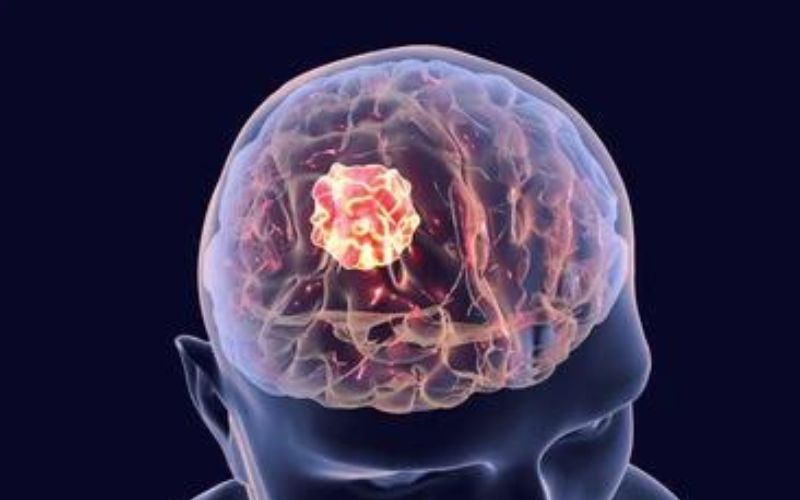
An intracranial tumor, commonly known as a brain tumor is an abnormal growth of cells or mass of tissue in the brain which divides uncontrollably. Skull, in which the brain is enclosed, is rigid in nature. Growth inside such rigid and restricted parts can create problems.
Generally, brain tumors are of different types. Some of them are malignant (cancerous) and some are benign (non-cancerous). About one-third of brain tumors are cancerous. Some of the tumors grow in size very quickly while some have slow progress. If the growth of tumors becomes large enough they will have a significant impact on brain function regardless of their nature benign or malignant. It will affect their surrounding blood vessels, nerves, and tissues. It can create pressure inside the brain which can be life-threatening. These tumors are also known as CNS (central nervous system) tumors.
Benign vs Malignant brain tumors:
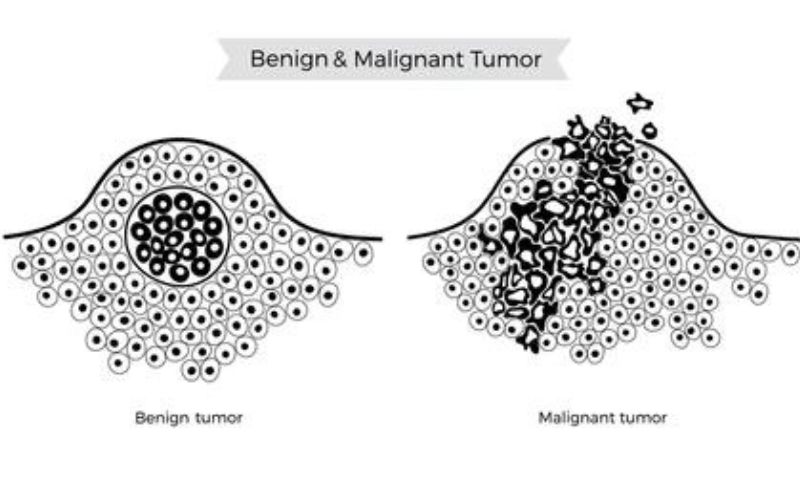
Benign and Malignant Tumor
Benign:
- Benign tumors are not cancerous but still they can cause serious complications.
- They grow gradually.
- Such tumors don’t spread to surrounding tissues.
- Benign tumors can be removed surgically.
Malignant:
- Malignant tumors are cancerous.
- They grow rapidly in size.
- Malignant tumors spread to other parts of the brain.
- Such tumors cause complications and can be life-threatening.
Types of Benign Brain Tumors
- Chordomas are slow-growing, benign tumors. Most common at age of 50-60. They are most commonly present at the base of the skull and the lower portion of the spine.
- Craniopharyngiomas
- Glomus jugulare These are benign tumors, commonly located under the skull base.
- Meningiomas
- Schwannomas are common benign tumors in adults.
Types of Malignant Brain Tumors
Categories of brain tumor:
There are two categories in which brain tumors are defined
- Primary tumors
- Metastatic brain tumors/ Secondary tumors
Primary tumors:
Brain tumors originate in the brain. Most of the primary tumors are benign. They can develop from brain cells, meninges (surrounding membranes of the brain), nerves, and glands. The most common type of primary brain tumors in adults are gliomas and meningiomas.
Metastatic brain tumors:
These are also known as secondary tumors. Such tumors form in different parts of the body such as lungs \ and breasts and spread to the brain.
Types of Primary brain tumors
Types of primary brain tumors include
- Pituitary tumors
- Meningiomas
- Pineal gland tumors
- Ependymomas
- Central nervous system (CNS) lymphomas
- Craniopharyngiomas
- Primary germ cell tumors of the brain
- Schwannomas
According to the studies, Meningioma is more common in women than in men. While Schwannomas occur equally in both genders. Both of them are rare but very aggressive.
Types of Secondary brain tumors
Majority of the brain cancers are of secondary types. They usually start at one side of the body and spreads to the brain. The following type of cancers can metastasize.
- Breast cancer
- Kidney cancer
- Lung cancer
Other Types of Brain Tumors
Risk factors for a brain tumor:
Research has shown that cancer is caused by damage to the genes of the chromosomes of the cell. The damaged gene doesn’t function properly.
Mechanism of brain tumor:
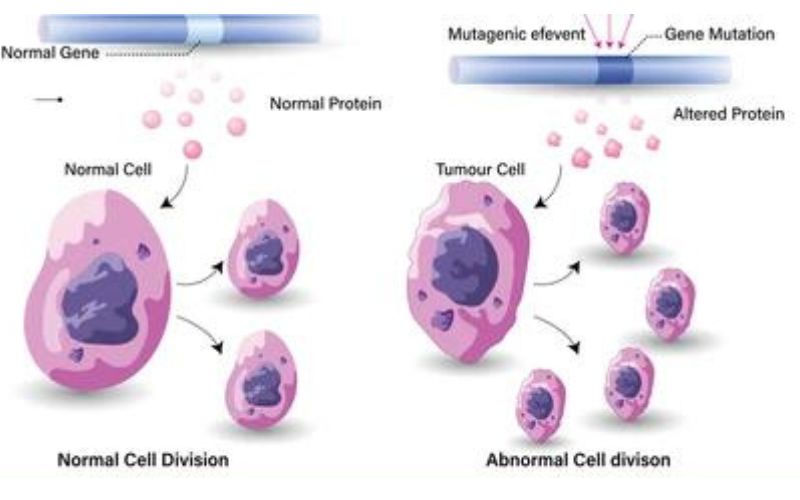
Mechanism of Brain Tumor
DNA present in the chromosomes gives instructions to the cell to perform tasks or to grow, divide or multiply and die when required. When the DNA in the brain cell changes, new instructions are given to the brain cells. With these new instructions, abnormal growth of cells occurs which multiplies the cells rapidly. This also lets the cell live for longer than normal. As a result, this aggregation of abnormal cells covers up the space in the brain.
In some cases, people are born with changes in genes that can be triggered or more damaging on exposure to various environmental factors such as X-ray radiation or previous cancer treatment. While in other cases, environmental injuries to the genes are the only cause of tumors.
However, there are a few inherited and rare genetic syndromes associated with brain tumors. These are
- Neurofibromatosis type 1 (NF1 gene).
- Neurofibromatosis type 2 (NF2 gene).
- Turcot syndrome (APCgene).
- Gorlin syndrome (PTCHgene).
- Tuberous sclerosis complex (TSC1andTSC2 genes).
- Li-Fraumeni syndrome (TP53gene).
Only about 5% to 10% of people with brain tumors have a family history of a brain tumor.
Some risk factors for brain tumors also include the following
- Family History – Only 5% to 10% patients of with brain tumors have a family history.
- Age
- Chemical exposure
- Radiation exposure
- No history of chickenpox
Symptoms of brain tumor:
Symptoms depend on the size and location of the brain tumor. Some have a direct impact on brain tissues while some attack the surrounding tissues of the brain. Following are the symptoms experienced by most people are
- Headaches (worse in the morning, can occur in sleeping, can be triggered by exercise, cough, or sneezing)
- Vomiting
- Blurred or double vision
- Confusion
- Seizures
- Weakness of one side of the limb
- Memory loss
- Clumsiness
- Difficulty writing and reading
- Changes in the ability to taste, smell or hear
- Loss of consciousness\ drowsiness
- Dysphagia
- Vertigo
- Behavioral changes
In some cases, there are no symptoms or they may develop gradually over time.
Diagnosis of brain tumor:
Diagnosing a brain tumor is a complicated process and requires a detailed investigation. The evaluation process includes
- Physical exam
- Neurological exam: It includes the following
- Balance and coordination.
- Mental status.
- Hearing.
- Vision.
- Reflexes.
Doctors may also evaluate
- Muscle strength
- Coordination
- Memory
- Ability to do mathematical calculations
Imaging may include the following
- CT Scan
- MRI
- Skull X-rays
- Angiography
- Biopsy
- Magnetic resonance spectroscopy (MRS)
- Positron emission tomography (PET scan)
Treatment of brain tumor:
Treatment of the brain tumor depends on the following
- Type of tumor
- Size of tumor
- Location of tumor
- General Health
The commonly used treatment for malignant tumors is Surgery. It aims to remove cancer as much as possible to prevent the healthy parts from damage. The limitation in this approach is the location of the tumor as in some cases the tumor is present at a safe place from where the removal is easy while in some cases the location of the tumor is at a site from where the removal is difficult. Since very little removal of tumors is also beneficial so the approach of surgery is taken in most conditions.
There are some risks involved with the surgery approach.
Risk factors that come with surgery are
- Infection
- Bleeding
Surgery is also combined with other treatment types. Such as
- Radiation Therapy
- Chemotherapy
Other treatments include:
- Laser Interstitial Thermal Therapy
- Investigational Therapies
- Immunotherapy
- Brachytherapy
- Targeted therapy
- Shunts
- Drugs such asmannitolandcorticosteroids
- Palliative care
After the neurosurgery, Physical therapy, occupational therapy, and speech therapy help in the recovery.