
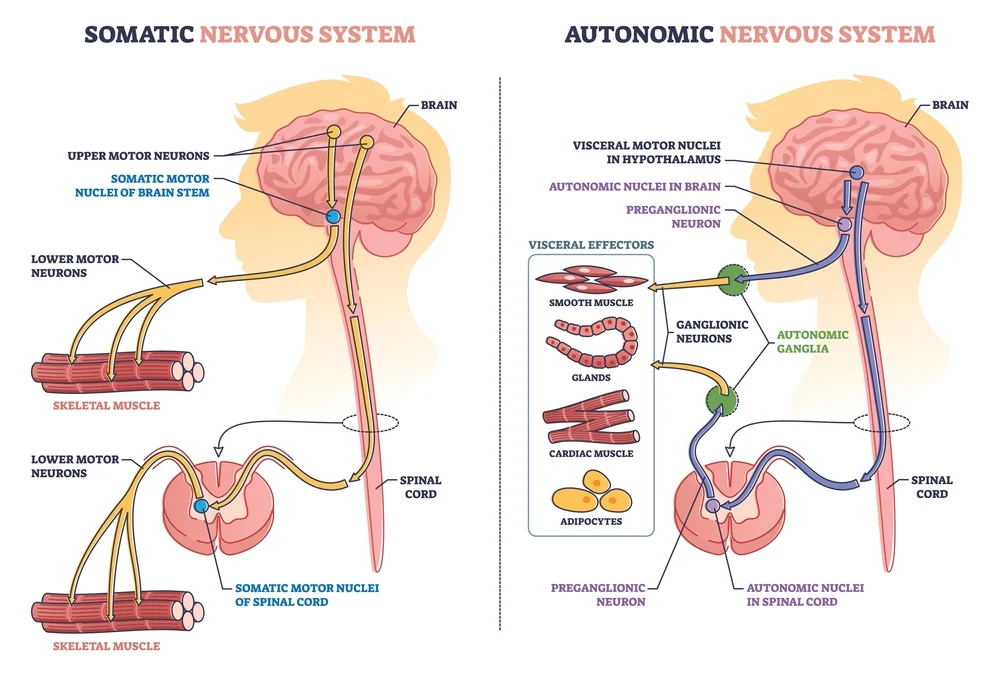
Reflexes are involuntary responses to any stimulus of the nervous system. A neural pathway that controls a reflex action is known as a reflex arc. There are two main types of reflex arc: the somatic reflex arc and the visceral reflex arc. Both are important for coordination between CNS (Central Nervous System) and the effector organ.
Somatic Reflex Arc: It is the reflex of the somatic nervous system that affects the muscles.
Visceral Reflex Arc: It is the reflex of the autonomic nervous system that affects the visceral organs (soft tissue organs).
Somatic reflexes involve the conscious perception of a stimulus, while visceral reflexes do not.
What is a Somatic Reflex?
Somatic reflex is the reflex of the somatic nervous system, which is part of the peripheral nervous system.
- The spinal cord, a part of the Central Nervous System, controls somatic reflexes.
- It produces unconscious motor responses such as contractions in skeletal muscles.
- Alpha motor neurons in the SNS (Somatic Nervous System) control the voluntary movements of muscles.
- Three main categories of somatic reflexes are as follows:
- Stretch Reflex
- Inverse Stretch Reflex- Golgi Tendon Organ
- Withdrawal Reflex
Mechanism of Somatic Reflex
- Stimulation of somatic receptors produces a somatic reflex.
- Afferent fibers carry the signal to the dorsal horn of the spinal cord.
- In the dorsal horn of the spinal cord, interneurons are present, which integrate the information and send it to the efferent fibers.
- The efferent fibers transmit the information to the skeletal muscles.
- In response to the signals, these skeletal muscles produce contractions.
What is a Visceral Reflex?
The visceral reflex is the autonomic nervous system reflex, often associated with the “Fight-or-Flight response.”
- It produces glandular, muscular reactions in soft tissue organs such as the heart, blood vessels, reproductive system, and intestinal organs.
- Most autonomic reflexes (visceral reflexes) are involuntary reflexes.
- Examples of visceral reflexes include the following:
- Sneezing
- Coughing
- Swallowing
- Dilation of the pupil
- Vomiting
- Contraction of smooth muscles of the hollow organs
Mechanism of Visceral Reflex
- It is a polysynaptic reflex.
- In the visceral reflex, the efferent pathways have two nerve fibers from the CNS to the effector organ.
- Stimulation of visceral receptors produces visceral reflex.
- The stimulus is transmitted to visceral sensory neurons.
- The integration center of the visceral reflex can be a preganglionic neuron, dorsal horn interneuron, or maybe the walls of the gastrointestinal tract.
- Further, these are transmitted to synapses at postganglionic neurons.
- After synapses, the signals are transmitted to a motor neuron, generating a visceral motor effector response such as contraction of cardiac and smooth muscles.
Top 5 differences between Somatic and Visceral Reflex

Somatic VS Visceral Reflex
Top 5 similarities between Somatic and Visceral Reflex

Similarities Between Somatic and Visceral Reflex