
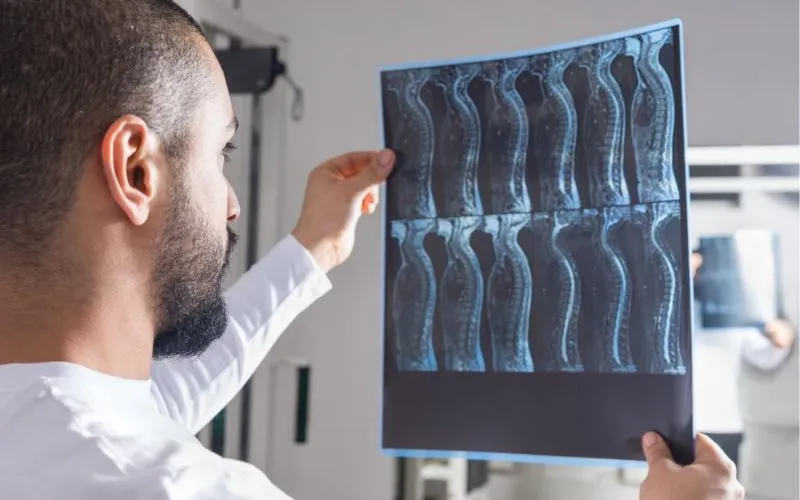
Spinal cord injuries occur due to trauma or damage to the spinal cord. It is protected by layers of meninges and vertebral column. Therefore, any sudden blow or trauma to vertebrae results in spinal cord injury. SCI can also be caused by trauma, such as a car accident, or a medical condition, such as a tumor or infection. Most of the time, spinal cord injury results in temporary or permanent paralysis. The type of damage depends on the location and site of the injury, such as paraplegia or quadriplegia (tetraplegia). However, in severe cases, the injury results in the splitting of the spinal cord. Symptoms of SCI can include pain, numbness, paralysis, and loss of bladder or bowel control.
Diagnosis of SCI (Spinal Cord Injuries)

Diagnosis of Spinal Cord Injury
Diagnosis of SCI usually involves a physical examination, imaging tests, and neurological tests. However, in emergencies, when a person arrives at the hospital after an accident, SCI are not always immediately recognizable. In such conditions, the spine is immobilized to prevent further damage and complications.
According to the National Spinal Cord Injury Statistical Center, there were 17,730 new spinal cord injury cases in the United States in 2018.
Early diagnosis after the trauma or accident depends on the following situations:
- If a person is conscious, the doctor will ask about the nature of the accident, and a physical assessment will be done to test the sensory function and movement.
- If a person is not fully conscious and complains about neck or head pain, the following injuries should be assessed to determine the spinal cord’s damage.
- Head injuries, particularly those with trauma to the face
- Penetrating spinal injuries
- Pelvic fractures
- Injuries from falling from heights
- If an injured person is unconscious and shows obvious signs of weakness and neurological injury, performing an emergency diagnostic test is necessary.
Diagnostic Tests for SCI
These tests include the following:
- X-rays or spine X-rays
- CT Scan
- MRI
- A Myelogram
- Somatosensory evoked potential (SSEP) testing or magnetic stimulation
X-rays or Spine X-rays
These X-rays reveal the changes in the spine or vertebral columns, such as tumors, fractures, damage to the spine’s bones, or degenerative spine changes.
CT Scan
CT scan (Computed Tomography) gives cross-sectional images to find the exact location and extent of the damage. It provides clear and more evident results than an x-ray. It also shows blood clots (hematomas) if present.
MRI
In MRI (Magnetic Resonance Imaging), a strong magnetic field and radio waves produce computer-generated images. This test identifies blood clots, herniated disks, and other masses that compress the spine.
A Myelogram
This kind of spine X-ray is performed after the administration of a dye. It indicates any abnormality in the spine, spinal column, or spine bones.
Somatosensory evoked potential (SSEP) testing or magnetic stimulation
This diagnostic test is performed to determine whether the nerve cells are intact. It also shows whether the nerve signals can pass through the spinal cord or not.
Neurological Examination for the diagnosis of SCI
After a few days of injury, the neurological assessment is done to diagnose the severity of the injury and predict the prognosis. The neurological test includes the evaluation of the following:
- Muscle Strength
- Ability to sense light and touch, such as pinprick.
If the signs and symptoms indicate SCI, doctors use the standard ASIA (American Spinal Injury Association) Impairment Scale for this diagnosis.
What is ASIA Impairment Scale for the diagnosis of SCI?
The ASIA Impairment Scale has five levels of classification. These classifications range from complete loss of neural function at the affected area to complete normal.
ASIA level A: This level indicates complete impairment. There is no sensory and motor function present below the level of injury.
ASIA level B: It indicates incomplete sensory impairment. In this level of injury, motor function is affected while the sensory function is intact below the neurological level (the first normal level above the level of injury). Sensations at sacral segments S4 and S5 are intact.
ASIA level C: This indicates incomplete motor impairment. Motor function is intact below the neurologic level, and more than half of the key muscles below the neurologic level have a muscle grade of less than 3 (i.e., they are not strong enough to move against gravity).
ASIA level D: It indicates incomplete impairment. Motor function is intact below the neurologic level, and half of the key muscles below the neurologic level have a muscle grade of 3 or more (i.e., the joints can be moved against gravity).
ASIA level E: It indicates normal sensory and motor functioning. All motor and sensory functions are unhindered.
Treatment Options for SCI

Treatment of Spinal Cord Injury
Unfortunately, there are no methods and ways to reverse the damage caused by spinal cord injury. However, doctors and researchers are continuously working and looking for advanced, effective strategies and techniques to recover the loss. This modern research includes using prostheses and medications to restore nerve cell function by promoting the regeneration of nerve cells.
However, in the meantime, the treatment of SCI includes preventing further injury or damage and empowering people to return to an active and productive life.
Treatment protocols are different depending on the condition and time of the injury. It includes the following:
- Emergency care
- Acute stages of treatment
- Management at Intensive Care Unit
- Ongoing Treatment
- Rehabilitation
Emergency care
- Urgent medical attention is essential to minimize the effects of head or neck injuries. Therefore, treatment often begins at the site of the accident.
- In emergency care, immobilize the spine as gently and quickly as possible using a rigid neck collar used during transportation to the hospital.
Acute stages of treatment
After the incident, when the patient is safely transported to the hospital, the management done by doctors in the emergency room includes the following:
- Maintaining the person’s ability to breathe.
- Safety measures to prevent shock.
- Immbolize the patient’s neck to prevent further spinal cord injuries.
- Management is done in order to avoid complications such as blood clot formation, urine retention, cardiovascular or respiratory complications, and deep vein thrombosis in the extremities, etc.
Management at Intensive Care Unit
It includes the following ways to manage SCI:
- Medications: Methylprednisolone (Solu-Medrol) is administered intravenously and has been used to treat acute spinal cord injury. However, recent studies show its potential side effects, such as the formation of blood clots and pneumonia.
- Immobilization: It is done to prevent further complications. Soft collars and braces are used to immobilize the neck, spine, or limb. In some cases, traction is also applied to align the spine.
- Surgery: In the case of fractures, surgery removes the fragments and pieces of the bone, herniated disk, or foreign objects that compress the spine. Sometimes, surgery is also required to align the spine or prevent any future deformity.
- Observational/ Experimental treatments: Scientists and doctors are trying to figure out advanced techniques to stop or prevent cell death, control inflammation and promote nerve regeneration. In this regard, a study shows that lowering body temperature significantly (a condition known as hypothermia) for 24 to 48 hours might help prevent damaging inflammation.
Ongoing Treatment
After managing early symptoms, doctors work to manage associated complications, such as deconditioning of muscles, pressure ulcers, muscle contractures, blood clots, respiratory infections, and bladder dysfunction.
Rehabilitation
Different kinds of rehabilitation are advised to the patient of SCI. These include the following:
- Physical Therapy: It is advised for the proper functioning and strength of muscles, communication, and mobility.
- Occupational Therapy: It focuses on fine motor skills.
- Recreational Therapy: It means engaging in sports and social activities because it helps them in relearning skills.
- Vocational Therapy: It helps people to get back to work by using assistive devices.
- Use of Assistive Devices: These devices include wheelchairs, walkers, and leg braces that help the injured person with mobility.
- Coping Strategies: It helps to deal with spasticity and pain.
- Use of Adaptive Devices: These are used for communication.
- Improved Strategies for Exercise and Diet: These are used to prevent obesity and diabetes, which is the greater risk factor for SCI patients.